TSR THLB Reconstruction Ladder
Purpose
Use this guide when you need the conceptual contract behind FEMIC’s TSA29 THLB reconstruction work, not just the command sequence.
This guide exists because three different things can look similar in chat or in status reports while still meaning different things:
the current hybrid executable bridge;
the promoted fragment-first reconstruction target; and
the TSR-reported benchmark areas that FEMIC is trying to explain or approach.
If those are blurred together, users and helper agents start comparing incompatible quantities and then report false convergence or false regressions.
Why AFLB and THLB Matter
Two upstream contracts matter more than almost anything else in a timber supply workflow:
AFLB defines the modeled universe.
THLB defines the harvest-eligible subset of that universe.
If AFLB is wrong, FEMIC is solving the wrong problem from the beginning. If THLB is wrong, the model may still run, but it is allocating harvest over the wrong eligible land base.
That is why FEMIC must not casually treat AU-only, VDYP-only, or yield-only filters as though they were automatically valid AFLB or THLB logic.
In particular:
young or regrowing productive stands are not automatically outside the AFLB;
low current volume is not automatically an AFLB exclusion;
AU / VDYP / curve filters are not automatically valid THLB filters; and
productivity or economic exclusions must come from explicit reviewed TSR logic with provenance.
The Reconstruction Ladder
FEMIC now treats the TSA29 THLB story as a staged land-base ladder rather than as a flat list of snippets:
GLB -> AFLBAFLB -> LHLBLHLB -> THLB
Those stage labels are now first-class review metadata in the THLB recipe and status/workbench surfaces.
Interpret them as follows:
GLB -> AFLBdefines the modeled universe and drops polygons from the working land base entirely.AFLB -> LHLBapplies legal or policy harvest exclusions to the remaining land base.LHLB -> THLBapplies projected operational, productivity, or other later harvest exclusions to the land base that remains.Reference targetsare benchmark or milestone rows, not deductions.Context / interpretationrows are support material, not executable exclusions.
For TSA29 specifically, Table 3 is the canonical backbone for step order
and benchmark areas. Section 6.2 / 6.3 / 6.4 provide the per-step
supporting rationale and explanatory prose. In other words, Section 6.2 /
6.3 / 6.4 provide the per-step supporting rationale, but they do not
override the Table 3 backbone.
When the current-cycle TSR wording is terse, older TSR cycles can still be useful hint documents. However, older-cycle TSRs are hints only, not silent replacements for the current-cycle record.
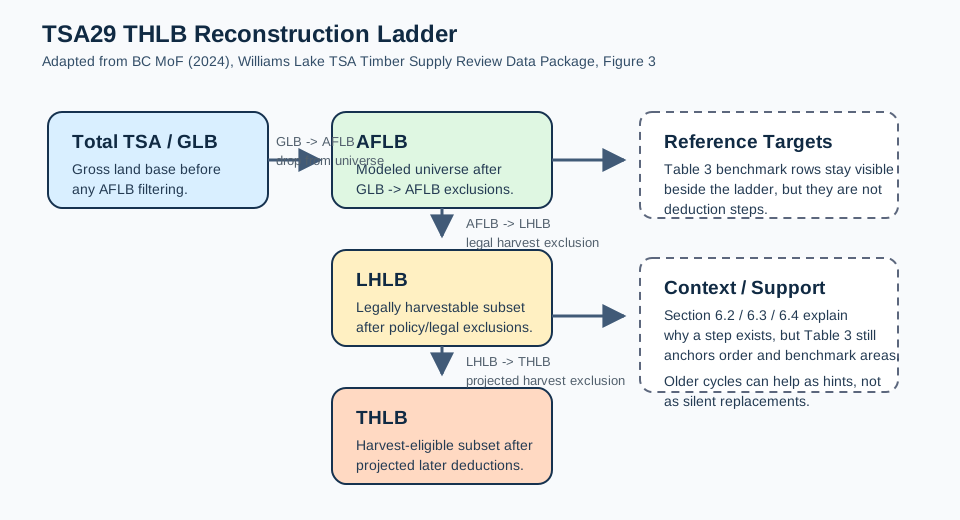
Adapted from BC MoF (2024), Williams Lake TSA Timber Supply Review Data Package, Figure 3.
Current FEMIC Execution Modes
FEMIC currently supports two different THLB stories, and they must not be confused.
Hybrid executable bridge
The current reviewed executable path is the hybrid THLB bridge:
it starts from an existing checkpoint that already carries a THLB-like signal;
it normalizes or preserves that checkpoint THLB signal as the execution baseline; and
it applies reviewed TSR exclusions on top of that baseline.
This path is useful because it is reproducible, reviewable, and already powers real TSA29 work. But it is not the same thing as reconstructing THLB from raw land-base truth.
Promoted fragment-first target
The promoted runtime path under #128 / #131 is the
fragment-first reconstruction lane:
start from the raw/resultant land-base geometry;
for current TSA29 strict validation, that means the validated strict-lane seam checkpoints under
data/tsr/rather than legacyria_vri_vclr1p_checkpoint*.featherfallback files;initialize the AFLB universe explicitly;
overlay the reviewed exclusion layers in stage order;
fragment the geometry where needed; and
assign binary fragment-level THLB membership
{0,1}.
That is now the default contract of
femic tsr thlb-netdown-run --execution-mode reconstructed.
Important boundary:
the hybrid bridge still exists as a separate executable lane;
reconstructed mode is fragment-first by default;
reconstructed exact spatial work is now LU-wise by default, so FEMIC cuts one Landscape Unit chunk at a time instead of trying to cut the whole TSA in one giant exact-overlay job;
reconstructed mode now supports exact spatial overlay plus explicit recipe-driven aspatial fallback where the reviewed recipe already carries a TSR target-area deduction;
when the reconstructed run reaches the AFLB milestone boundary, FEMIC now emits
data/tsr/aflb_checkpoint.featheras the canonical downstream restart artifact anddata/tsr/aflb_checkpoint.gpkgby default as the GIS-facing companion;later-stage experimentation should prefer restarting from
--checkpoint-path data/tsr/aflb_checkpoint.featherinstead of rebuilding GLB -> AFLB every time;when the reconstructed run reaches the LHLB milestone boundary, FEMIC now emits
data/tsr/lhlb_checkpoint.featheras the canonical raw post-step-12 restart artifact anddata/tsr/lhlb_checkpoint.gpkgby default as the GIS-facing companion;strict late-stage execution then promotes that raw LHLB restart into
data/tsr/lhlb_curve_ready_checkpoint.featherplus a defaultdata/tsr/lhlb_curve_ready_checkpoint.gpkgcompanion so steps13+can reuse the deterministic terrain-/curve-ready fields they require;THLB-only experimentation should prefer restarting from
--checkpoint-path data/tsr/lhlb_curve_ready_checkpoint.featherinstead of rebuilding AFLB -> LHLB every time;blocked exact-overlay seams still remain explicit instead of being silently converted into fallback; and
the old coarse stand-binary approximation survives only as an explicit non-default debug fallback, not as silent normal behavior.
Fallback and Review Paths
FEMIC v1 needs two honest user paths.
Preferred path
The preferred path is:
reviewed recipe scaffolds;
LLM/coding-agent assistance to accelerate review and iteration; and
explicit overlays / overrides when public inputs do not finish the job.
This path is usually the fastest way to converge on a benchmarked TSA29 read, but it still depends on reviewed artifacts and provenance-preserving edits.
Fallback no-LLM path
The fallback path is:
reviewed recipe scaffolds;
a human analyst with no LLM available; and
generated review/workbench surfaces that behave as a warm-start checklist rather than dumping the user into raw JSON.
That means the no-LLM path is not an afterthought. It is part of the FEMIC v1 contract.
Blocked or approximate seams must also stay explicit:
blocked/manual means FEMIC does not yet have a trustworthy executable path for that clause;
override/overlay means the user intentionally substituted a reviewed source or interpretation seam and kept provenance;
aspatial fallback means FEMIC is using a documented area-reduction bridge rather than exact spatial truth; and
none of those should be presented as though they were the same as exact fragment-level overlay.
Comparison Contract
When users say “how close are we?”, the first question should be:
Close to which reference surface?
For TSA29 there are three different comparison surfaces:
Reconstructed THLB The fragment/resultant target path that starts from raw land-base geometry and assigns binary THLB membership.
Legacy raster-derived THLB The historical checkpoint/raster signal that still seeds the hybrid bridge.
TSR-reported THLB The benchmark areas reported in the Williams Lake TSR package.
Those comparisons are useful only when the runner, checkpoint, scope, and stop-line are compatible.
Good comparison examples:
hybrid-vs-TSR for the same accepted parent-step stop-line;
reconstructed-vs-TSR for the same stage/step ledger; and
reconstructed-vs-legacy-raster to understand how much of the difference is coming from the old baseline rather than from later exclusions.
The plain-language comparison surface for this is now:
python -m femic tsr thlb-reconstruction-compare --instance-root ...
That command reads the existing reviewed and reconstructed TSA29 artifacts and emits a parent-step report that shows:
strict reconstructed THLB vs TSR-reported THLB as the governing benchmark;
reviewed bridge THLB vs TSR-reported THLB as context for why the reviewed lane was accepted;
strict reconstructed vs reviewed bridge deltas as explanatory context rather than the main score; and
which parent steps currently look: - close enough to TSR; - materially high or low against TSR; - blocked or missing-data driven; - or like accepted reviewed bridge / fallback territory.
Important practical interpretation:
the reviewed lane was accepted because its cumulative THLB is close enough to the TSR benchmark for exploratory case-study use;
that does not make reviewed per-step behavior the automatic gold standard for strict reconstruction; and
a strict parent step becomes a top-priority repair when it is materially bad against TSR, not merely because it differs from the reviewed lane.
Bad comparison examples:
comparing a generic flattened full-recipe run against a reviewed parent-step cumulative benchmark as though they were the same metric;
comparing a smoke-subset run to a full-TSA cumulative target without saying it is a smoke-only proving ground; and
comparing a step-20 cumulative read to a step-23 TSR target without carrying the downstream steps honestly.
Cumulative comparisons are therefore meaningful only when:
the same runner family is used;
the same baseline/checkpoint family is used;
the same geographic scope is used; and
the same stop-line or final step is being compared.
For the live TSA29 adjudication pass, FEMIC now carries one extra guardrail:
config/tsr/thlb_locked_chain_ledger.jsonis the canonical chained source for locked cumulative remaining area and TSR cumulative deltas; andbranch-local bounded step outputs are valid for stepwise net deductions, but they are not cumulative unless and until they are promoted into that locked chain ledger.
THLB Accounting Directives
FEMIC stepwise accounting now has one shared rule across strict, reviewed, and comparison surfaces:
the canonical marginal metric is
net_removed_area_ha; andit must equal the true before/after change in currently active managed area caused by that step at the moment it runs.
That means FEMIC must not present any of the following as though they were the main stepwise deduction:
gross candidate area;
gross matched overlay area;
gross area touched by an aspatial fallback or scaling operation; or
residual benchmark target area.
Those values can still be useful diagnostics, but they are secondary.
Important consequences:
milestone or reference rows do not have a marginal deduction;
milestone rows report only remaining/cumulative state and benchmark deltas;
exact overlay steps report net active-area change after applying to the current state; and
aspatial fallback steps report the net change that actually landed on the current active state, not just the requested target.
Accepted skips or no-op tail steps also need plain interpretation:
they mean FEMIC reviewed the clause and chose to record an explicit
no_deductionor skipped state for the accepted lane;they do not mean the clause vanished from the TSR;
and they should stay visible in status/workbench surfaces so later reviewers can see what was accepted, skipped, blocked, or still unresolved.
Worked TSA29 Read
The current accepted TSA29 closeout gives a compact example of the comparison contract.
The accepted lane stops treating step
023as a positive deduction because the same-instrument parent-step reruns showed the post-step-021result was already below the final TSR cumulative target.That means an additional positive step-
023deduction would move FEMIC farther away from the TSR cumulative target, not closer.So the accepted closeout records step
021as the last active tail deduction and step023as an explicit reviewed0 hano-op tail step.
The important lesson is not the exact hectare number. The important lesson is the method:
compare like with like;
keep the runner and stop-line explicit;
distinguish reviewed no-op logic from blocked logic; and
keep the benchmark explanation auditable in the recipe/status/workbench surfaces.
How This Guide Fits the Other Docs
Use the other docs for different jobs:
TSR Intelligence Workflow for the operational review/build/run flow;
How to Interpret Rebuild Reports and Regressions for reading FEMIC rebuild evidence more generally;
CLI Reference for command syntax and option surfaces; and
Stage Boundaries and Canonical Artifacts for adjacent stage-boundary contracts.
Use this guide when you need the conceptual ladder, the benchmark comparison contract, and the hybrid-vs-reconstructed distinction stated plainly in one place.